
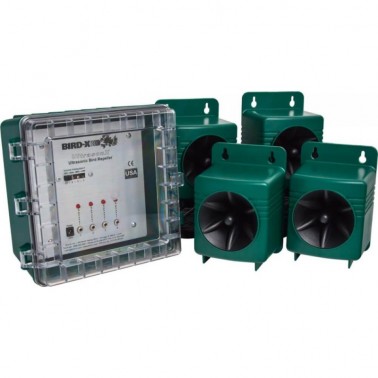
Ultrasonic Bird Repellers
 4 reviews
- On sale!
- Promotion


Ultrasonic Bird Repellers: discreet and silent
Ultrasonic bird repellers emit high-frequency sounds, largely inaudible to people, with the aim of creating an uncomfortable environment for certain animals. Their main advantage is discretion: they allow you to act without generating annoying noise for neighbours or customers, making them suitable for urban, commercial or sound-sensitive environments.
This category also responds to frequent searches such as ultrasonic pigeon repeller, ultrasound for pigeons, ultrasonic bird emitter or ultrasonic bird repellent. Even so, it is important to understand when this technology may make sense and when another solution should be chosen.
Unlike sonic bird repellers, which use chips with recordings specific to each species, ultrasonic devices are universal in terms of the equipment: the same device is used regardless of the species. This does not mean they work on all birds; it means you do not need a different model for each species.
Do ultrasonic devices work against birds?
Most birds hear better at lower frequencies, approximately around 1–5 kHz, and perceive very high-pitched sounds less effectively. Based on our experience and the available evidence, ultrasound is not effective for most birds, and where there may be some effect, birds tend to become habituated.
This is especially important in common problems involving pigeons, sparrows, seagulls, starlings and other urban or agricultural birds. If the birds are already established, have fixed perching points or keep returning for food, shelter or nesting, an ultrasonic device on its own will normally not be the main solution.
That is why, for general bird problems, we recommend solutions with an audible sonic component, such as distress calls and predator sounds in the frequency range that birds do perceive better, such as the BroadBand Pro, which combines sound and ultrasound, or directly sonic bird repellers.
Ultrasound for pigeons: what you should know
Many people search for ultrasound for pigeons because they want a silent solution for balconies, patios, residential communities, garages, warehouses or areas where it is not convenient to disturb neighbours or workers. In that sense, ultrasound is attractive because it does not create the same acoustic impact as a sonic bird repeller.
However, in the case of pigeons, it is especially important to be cautious. Pigeons tend to develop a strong attachment to places where they find food, shelter or comfortable perching points. If they are already used to a ledge, roof, balcony, covered area or structure, ultrasound may have a very limited effect.
For pigeons, it is usually more effective to work with a combined strategy: prior cleaning, removal of food remains, blocking access points, anti-perching systems on the points where they land and, when the environment allows it, sonic bird repellers or mixed solutions such as the BroadBand Pro.
If your main problem is pigeons, you can also visit our dedicated page on how to repel pigeons.
The real niche for ultrasound: species with strong hearing sensitivity
Ultrasound may be useful with animals that are highly sensitive to high frequencies, such as swallows, swifts or bats — the latter use ultrasonic frequencies for echolocation. In these cases, it may help to discourage nesting at a specific point before the animals become established.
Important notice: swallows, swifts, bats and other species may be subject to specific protection rules or restrictions. Before acting on animals, nests, roosts or access points, you should consult the competent authority and confirm whether prior authorisation is required. This information is for guidance only and does not constitute legal advice.
Our ultrasonic devices
| Device | Technology | Frequency | Coverage | Best suited for |
|---|---|---|---|---|
| UltraSon X (Bird-X) | Ultrasound, silent for people | 15–25 kHz | Up to 350 m² | Discreet deterrence for species with strong hearing sensitivity, such as swallows or bats, and semi-enclosed spaces where silence is a priority. |
| BroadBand Pro (Bird-X) | Sound + ultrasound: distress calls and predator sounds + ultrasonic component | Sonic 3–5 kHz and ultrasonic 15–25 kHz | Up to 24,000 m² with the sonic component / 350 m² with the ultrasonic component | General bird problems, especially on large surfaces, outdoor areas or cases where a more complete solution is needed. |
Both devices are programmable and weather-resistant, and the same equipment is used regardless of the species. On each product page you will find the full specifications and customer reviews.
UltraSon X: pure ultrasound for specific areas
The UltraSon X is an ultrasound-based device designed to act discreetly in spaces where audible noise needs to be avoided. It may be considered for small or semi-enclosed areas, such as garages, warehouses, patios, porches or specific points where you want to add a high-frequency stimulus.
We would not present it as the best option for most general bird problems, especially when dealing with well-established pigeons or large surfaces. In those cases, it is usually more appropriate to consider a solution with audible sound, anti-perching systems or a combined strategy.
BroadBand Pro: audible sound + ultrasound
The BroadBand Pro combines audible sounds and ultrasound. That is why it is usually a more complete option for general bird problems, as it does not rely solely on ultrasound but also includes distress calls and predator sounds at frequencies birds perceive better.
It may be an interesting alternative when you need to cover larger surfaces or when the problem is not limited to one very specific point. However, because it also emits audible sounds, it is important to assess whether the environment allows this type of operation.
Where ultrasound can fit
- Industrial buildings, warehouses, garages and car parks: semi-enclosed spaces where discretion is important and constant audible sound should be avoided.
- Patios, porches and commercial areas: places where annoying sound for customers, neighbours or workers is not desirable.
- Balconies, terraces and residential communities: specific areas where a discreet solution is sought, although for pigeons it may be necessary to combine it with anti-perching or cleaning.
- Specific access, perching or shelter points: especially when action is taken before the problem becomes well established.
For large open outdoor areas or general bird problems, the sonic component of the BroadBand Pro or sonic bird repellers usually performs better.
How to get the best results
- Combine stimuli: combining sound or ultrasound with visual bird repellers, such as hawks, owls or reflective tape, can reinforce the effect and reduce habituation.
- Use programming options: varying volume, intervals and patterns helps prevent animals from getting used to a fixed stimulus.
- Pay attention to placement: aim the speakers towards the areas to be protected and avoid obstacles that may block the emission.
- Act early: it is easier to discourage birds before they settle than to move them once they already have nests, shelter or habitual perching points.
- Reduce site attachment: clean droppings, feathers, food remains or nesting material before installing any system.
- Be realistic: no acoustic method is 100% effective; the goal is to reduce and displace animal pressure.
Frequently asked questions about ultrasound for birds
Do ultrasonic devices work to repel birds?
For most birds, they are not the main solution: many birds hear lower frequencies better, and ultrasound has a very limited effect, with a risk of habituation. For bird problems, we recommend solutions with audible sound, such as the BroadBand Pro or sonic bird repellers. Ultrasound is more useful with species with strong hearing sensitivity, such as swallows or bats.
Do ultrasonic devices work to repel pigeons?
In pigeons, ultrasonic devices may have a limited effect, especially if the birds are already established or have fixed perching points. For pigeons, it is usually more advisable to combine cleaning, anti-perching systems, access blocking and, where the environment allows it, audible sound or mixed solutions.
Why is the equipment described as universal?
Because, unlike sonic bird repellers, which use a species-specific sound chip, ultrasonic devices use the same equipment regardless of the species. Universal refers to the device, not to the idea that it works on all birds.
Can I use ultrasound against swallows, swifts or bats?
Before acting on swallows, swifts, bats, nests or roosts, you should consult the competent authority. These species may be subject to specific protection rules or restrictions, and in some cases prior authorisation may be required.
Can people or pets hear ultrasound?
Most of the emission is above the human hearing threshold, although some younger people may perceive the lower frequencies. Dogs and cats can perceive high frequencies, so this should be taken into account when choosing the installation location.
UltraSon X or BroadBand Pro?
The UltraSon X is the discreet, purely ultrasonic option for small, specific or semi-enclosed spaces. The BroadBand Pro is more complete for general bird problems because it adds audible sound, which can generate a clearer response in many birds, and covers much larger surfaces.
Not sure which solution to choose?
If you are unsure whether to choose ultrasound, sound or another technology, visit our guide by type of bird repeller or check our solutions by species, such as swallows, pigeons or seagulls. If you prefer, contact our team and we will advise you according to your case.