
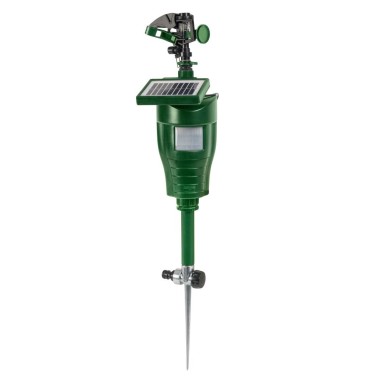
Water-based Animal Repellers
 4 reviews
Water-based animal repellers use a motion-activated water jet to deter animals from gardens, vegetable patches, terraces, lawns and specific outdoor areas. They do not use poisons or chemicals: the animal is startled, associates that area with an unpleasant experience and tends to avoid it.
Among the types of animal repeller, water systems are a practical option for clearly defined outdoor spaces, especially when the animal usually enters through the same point. They are not designed to cover large estates, but they can work very well in gardens, vegetable plots, entrances, regular paths or planting areas you want to protect.
How a water-based animal repeller works
The principle is simple: the unit includes a motion sensor that detects the animal in the protected area. When the animal enters the detection zone, the sprinkler releases a short water jet that startles it and encourages it to move away.
The purpose is not to harm the animal, but to create an unexpected and uncomfortable experience. Over time, many animals learn that the area is not pleasant and stop entering it as often.
This type of system is especially useful when the problem is localised: a garden entrance, a patch of lawn, a vegetable bed, a terrace, a passage point or an area where the animal usually digs, marks or eats plants.
Which animals can a motion-activated sprinkler help with?
Water repellers can be used against different animals, provided the problem occurs in a defined outdoor area and the device can be connected to a water supply.
| Animal | Recommended use | Notes |
|---|---|---|
| Cats | Gardens, terraces, pots, vegetable plots, lawns and passage areas | One of the most common uses. Aim the sprinkler at the entry point or the area where the cat digs, marks or rests. |
| Dogs | Entrances, marking areas, lawns, flower beds or specific paths | It can help when a dog repeatedly enters one area, although it does not replace a physical barrier where permanent access control is required. |
| Rabbits | Vegetable gardens, raised beds, low plants and small crops | It can protect feeding areas, especially when combined with good placement and removal of attractants. |
| Deer and roe deer | Gardens, small vegetable plots or specific entry points | Useful as local support. For large plots or crops, sound, light or repellents may be more suitable. |
| Foxes | Gardens, vegetable plots or outdoor areas where they roam | It can reinforce deterrence, but around chicken coops the priority should be physical closure, food removal and, where appropriate, deterrent light. |
Motion Activated Sprinkler
The Motion Activated Sprinkler is the water-based solution we recommend for protecting specific outdoor areas. It detects animal movement and activates a water jet that startles the animal without poisons, chemicals or bait.
It is especially useful for gardens, vegetable plots, terraces, lawns, flower beds, entrances and passage areas where the animal appears repeatedly. For correct operation, connect it to a water supply, aim it carefully and place it towards the point where the animal enters or causes damage.
Advantages of water-based animal repellers
A motion-activated sprinkler is simple, visible and easy to understand. It requires no bait, uses no chemical products and activates only when it detects movement.
- No poisons or chemicals: the goal is to deter the animal through an unexpected stimulus.
- Activates only when it detects movement: it is not running continuously, only when the animal enters the protected zone.
- Useful against different animals: it can be used for cats, dogs, rabbits, foxes, deer or roe deer in specific areas.
- Movable: you can change its position if the animal changes its entry route.
- Good for plants and vegetable gardens: it helps protect specific areas without applying repellents directly to vegetation.
- Can be combined with other methods: in persistent problems, it can be reinforced with ultrasound, light, repellents or physical barriers.
Limitations of water-based animal repellers
Water repellers can work very well in the right situation, but they are not the best option for every space. Before choosing this technology, it is worth understanding its limits.
- They need a water supply: the unit must be connected to a hose or water point.
- They require enough pressure: if pressure is low, the water jet range may be reduced.
- They are not for indoor use: they are designed for outdoor spaces.
- They are not ideal for large areas: they work best in specific zones, not across extensive land.
- They may wet passage areas: aim the sprinkler carefully to avoid doors, paths, neighbours, pets or people.
- Frost requires caution: in very cold periods, review the use of the device and the water installation.
- They do not replace prevention: if the animal finds food, shelter or easy access, other measures may also be needed.
How to place a motion-activated sprinkler correctly
Placement is essential. The sprinkler should point towards the animal's entry point or the area you want to protect, rather than being placed randomly in the middle of the garden.
- Identify the passage area: observe where the animal enters, digs, marks or which plants it damages.
- Aim the sensor at that area: the device must detect the animal before it reaches the sensitive point.
- Test the range: walk in front of the sensor to check that it activates and that the water jet covers the correct area.
- Avoid wetting unwanted areas: adjust the angle so it does not spray doors, public paths, neighbours or regular-use zones.
- Move it if needed: if the animal changes route, reposition the unit to cover the new entry point.
- Remove attractants: store pet food, rubbish, feed, fallen fruit and anything else that could attract the animal.
Comparison with other animal repeller technologies
Water repellers are very useful, but they are not always the most suitable technology. The right choice depends on the animal, surface, environment and type of damage.
| Repeller type | Best fit |
|---|---|
| Water | Gardens, vegetable plots, terraces, lawns and specific outdoor areas with a water supply. |
| Ultrasound | Indoor areas, defined gardens, PIR sensors, vehicles or spaces where a high-frequency acoustic deterrent is useful. |
| Light | Nocturnal animals, rural areas, pens, chicken coops or points where simulated presence can help. |
| Sound | Larger surfaces, farms, crops or open spaces where more coverage is required. |
| Repellents | Plants, shoots, trees, specific areas or cases where smell or taste deterrence is preferred. |
| Physical barriers | When access must be prevented constantly or a vulnerable point needs fixed protection. |
Frequently asked questions about water-based animal repellers
Do water-based animal repellers work?
Yes, they can work very well when the problem is localised in a specific outdoor area. The sensor detects the animal and activates a water jet that startles it, encouraging it to avoid that zone.
Which animals can a motion-activated sprinkler deter?
It can be used against cats, dogs, rabbits, foxes, deer, roe deer and other animals entering gardens, vegetable plots, terraces or defined outdoor areas. The key is that the animal passes through an area where the sensor can detect it.
Can it help keep cats out of the garden?
Yes, this is one of the most common uses. A motion-activated sprinkler can help prevent cats from entering the garden, digging in pots, marking areas or approaching a vegetable plot or flower bed.
Can it be used for dogs?
Yes, it can be useful if a dog repeatedly enters a specific area, marks, digs or uses a regular path. It is not designed to cover large surfaces and does not replace a physical barrier when permanent access prevention is needed.
Can I use it in a vegetable garden?
Yes. It can be a good option for protecting raised beds, low plants, vegetable garden entrances or areas where rabbits, cats or other animals enter. Aim the water jet carefully so it protects the sensitive area without wetting unnecessary zones.
Does it need a water supply?
Yes. The sprinkler must be connected to a hose or water point and needs enough pressure for the jet to reach the target area.
Does it work at night?
Yes, as long as the sensor detects the animal's movement and the unit is correctly connected. It can help with animals entering at dusk, during the night or at dawn.
Can it spray people or pets?
Yes. If it is aimed at a passage area, it can be triggered by people, pets or animals that were not the target. That is why orientation, range and detection area must be adjusted carefully.
Is it suitable for large areas?
It is not the best choice for large areas. Water-based repellers work better in specific zones such as entrances, vegetable plots, flower beds, terraces, lawns or repeated passage points. For large plots, sound, light or repellents are often more suitable.
What should I do if the animal gets used to it?
If the animal changes route or gets used to the device, move the sprinkler, adjust its orientation and remove attractants such as food, rubbish, feed or shelter. In persistent cases, combine it with ultrasound, light, repellents or physical barriers.
Water-based animal repellers at BirdGard Iberia
At BirdGard Iberia you will find water-based solutions such as the Motion Activated Sprinkler, a practical option for protecting specific outdoor areas without poisons or chemicals. If you are not sure whether this technology fits your case, contact us and we will advise you free of charge.