
Moths
Moths at home can cause significant damage to clothes, carpets, upholstery, books and stored food. One key point is worth knowing from the start: the adult moths you see flying are not the ones that cause the direct damage. The damage is caused by their larvae, which feed on natural fibres or dry pantry products.
That is why controlling moths is not just about chasing the ones that fly around. The real goal is to find the source, remove what is affected and interrupt the breeding cycle. This guide explains how to tell clothes moths from pantry moths, how pheromone traps work and what to do to prevent them from coming back. For other household insect solutions, return to Pest Control - Insects.
What to do depending on the moth problem
| Situation | Likely moth type | What to do |
|---|---|---|
| Holes in clothes, jumpers, coats or wool fabrics | Clothes moth | Check the wardrobe, wash or clean affected garments, ventilate and place a pheromone trap. |
| Moths flying near the pantry | Food moth | Check flour, cereals, pasta, rice, pulses, nuts, seeds and pet food. |
| Larvae, threads or fine webbing in dry food | Pantry moth | Remove infested products, clean shelves and store food in airtight containers. |
| Moths in closed wardrobes | Clothes moth | Empty the wardrobe, check rarely used garments, clean corners and protect seasonal clothing. |
| You see adult moths but do not know where the source is | Clothes or pantry moth | Use a pheromone trap to detect activity and help locate the affected area. |
| They reappear after cleaning | Source not removed | Check forgotten packets, joints, corners, stored garments and poorly ventilated areas. |
Two moth types, two different problems
Before acting, identify whether the problem is in clothes or food. Both require cleaning, removal of the source and pheromone traps, but the origin and prevention steps are different.
Clothes moth
The clothes moth attacks natural-fibre textiles such as wool, silk, linen, cotton, fur, carpets, upholstery and garments stored for long periods. Larvae can leave holes in jumpers, coats, blankets and seasonal clothing, especially in closed, dark and poorly ventilated wardrobes.
Food moth or pantry moth
The food moth appears in dry products such as flour, cereals, rice, pasta, pulses, nuts, seeds, biscuits or pet food. It is often detected through small moths near the pantry, larvae in packets, fine webbing, cocoons or clumped food.
Signs that you have moths
Moths are not always detected early. Often, damage appears once the larvae have already been feeding for some time. Common signs include:
- Adult moths flying: they usually indicate activity, although they do not always show where the source is.
- Holes in clothes: especially in wool, silk, coats, jumpers, carpets or stored garments.
- Larvae or small worms: they may appear in dry food, wardrobes or corners.
- Fine webbing in food: a common sign of pantry moths.
- Cocoons or residues on shelves: they may be found in corners, joints or packaging.
- Clumped food: flour, cereals or nuts with threads or lumps may be affected.
- Repeated activity in the same area: if you always see moths in the same wardrobe or pantry, the source is probably nearby.
How pheromone traps for moths work
Pheromone traps for moths release a pheromone that attracts adult males. When they approach, they are caught on an adhesive surface. This reduces the chance of reproduction and helps interrupt the pest cycle.
Traps also have a very useful detection and monitoring function. If a trap starts catching moths, it shows there is activity in that area and helps locate the source.
It is important to be clear: traps act on adult moths, but they do not remove larvae already installed. They must be combined with cleaning, checking wardrobes or pantries and removing affected products or garments.
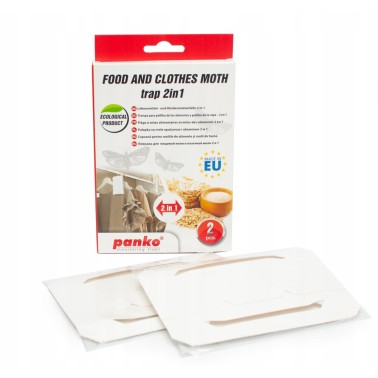
The Food and Clothes Moth Trap is a pack of 2 insecticide-free traps. Each trap protects up to 100 m² and can be used to control and monitor clothes moths and food moths in wardrobes, pantries, kitchens and indoor areas.
How to eliminate clothes moths
If the problem is in clothes, carpets or wardrobes, the objective is to remove larvae, eggs and organic residues that can serve as food.
- Empty the wardrobe: check all garments, especially those stored for a long time.
- Clean thoroughly: vacuum corners, shelves, drawers, joints, edges and hard-to-reach areas.
- Check seams and hems: larvae can hide in discreet parts of the garment.
- Wash or dry-clean affected clothes: heat, intense cold or professional cleaning helps remove eggs and larvae.
- Store clothes clean and dry: do not store garments with sweat, stains or organic residues.
- Use closed covers or bags: especially for seasonal clothes, wool, silk and delicate garments.
- Ventilate wardrobes: closed, dark and undisturbed areas encourage activity.
- Place a pheromone trap: it helps catch adults and detect whether activity continues.
How to eliminate pantry moths
If moths appear in the kitchen or near dry food, the source is usually an infested packet. In this case, surface cleaning is not enough: each product must be checked.
- Check all dry food: flour, cereals, pasta, rice, pulses, nuts, seeds, biscuits and pet food.
- Remove affected products: discard packets with larvae, threads, cocoons or clumped food.
- Do not mix new food with old food without checking: one infested packet can contaminate the rest.
- Clean shelves, joints and corners: larvae can hide in pantry gaps.
- Store food in airtight containers: glass or rigid plastic with a good seal is best.
- Check forgotten packets: many infestations start in open or old products.
- Place a pheromone trap: it helps interrupt the cycle and confirm whether activity continues.
Where to place moth traps
Placement matters. Pheromone traps should be positioned near the suspected activity area, without touching open food or being buried between clothes.
- In wardrobes: place the trap in a visible, ventilated area inside or near the affected wardrobe.
- In dressing rooms: position it near wool garments, coats, carpets or stored clothing.
- In pantries: place it near dry food, but without direct contact with open food.
- In kitchens: if you see moths near cupboards or dry packets, place the trap close to the source.
- In large rooms: distribute traps according to activity areas and the product instructions.
- For several weeks: do not remove them too soon; they are useful for capture and monitoring.
Do not place traps randomly all over the house without checking the source. The trap helps, but real control starts by finding and removing the origin of the problem.
What not to do if you have moths
Some mistakes make moths reappear even when the problem seems to have been reduced.
- Do not only kill flying moths: larvae cause the damage and the source may still be active.
- Do not store used clothes without washing: stains, sweat or organic residues can attract larvae.
- Do not keep suspicious packets: if there are larvae, threads or cocoons, remove them.
- Do not leave dry food in open packaging: flour, cereals, rice and nuts should be stored airtight.
- Do not place a trap and forget to clean: traps do not remove larvae already installed.
- Do not mix new and old food without checking: you can spread the problem through the pantry.
- Do not ignore closed wardrobes for months: stored clothing without ventilation is more vulnerable.
How to prevent moths from coming back
Prevention is essential, especially in wardrobes and pantries where items that feed larvae are stored.
- Store clothes clean and dry: especially wool, silk, linen, coats and seasonal clothing.
- Use closed covers: they help protect delicate or rarely used garments.
- Ventilate wardrobes and dressing rooms: avoid closed, undisturbed areas for long periods.
- Check the pantry often: especially flour, cereals, nuts, pulses and pet food.
- Use airtight containers: they reduce the risk of contamination between products.
- Rotate dry food: do not leave open or old packets forgotten for months.
- Keep a pheromone trap for early detection: it can alert you before the problem grows.
Frequently asked questions about moths
How do I eliminate moths from the house?
To eliminate moths, locate the source, remove affected clothes or food, clean wardrobes or pantries thoroughly and place pheromone traps to capture adults and interrupt the breeding cycle.
What is the difference between clothes moths and food moths?
Clothes moths damage natural-fibre textiles such as wool, silk, linen or carpets. Food moths appear in dry products such as flour, cereals, rice, pasta, nuts or pet food.
Are flying moths the ones that make holes?
No. Adult flying moths are not the ones that cause direct damage. Holes in clothing and damage to food are caused by larvae, which is why it is important to find the source and interrupt the cycle.
How do pheromone traps for moths work?
They attract adult males using pheromones and hold them on an adhesive surface. By capturing males, they help reduce reproduction and detect whether there is activity.
Do traps eliminate moth larvae?
No. Traps act on adults, not on larvae already installed. They must be combined with cleaning, removal of affected products and checking wardrobes or pantries.
Where should moth traps be placed?
Place them near the activity area: wardrobes, dressing rooms, pantries, kitchens or rooms where you see moths. They should be visible and not in direct contact with open food.
How do I eliminate clothes moths?
Empty and clean the wardrobe, check affected garments, wash or dry-clean clothes, store clean and dry garments in closed covers and place a pheromone trap to monitor activity.
How do I eliminate pantry moths?
Check all dry food, remove products with larvae, threads or cocoons, clean shelves and corners, store food in airtight containers and place a pheromone trap for monitoring.
Why do moths reappear after cleaning?
Usually because a source remains: an infested packet, an affected garment, larvae in corners or old food that was not checked. Traps help, but the origin of the problem must be removed.
How can I prevent moths from coming back?
Store clothes clean and dry, ventilate wardrobes, protect seasonal garments, check dry food, use airtight containers and keep pheromone traps as an early detection system.
Moth solutions at BirdGard Iberia
At BirdGard Iberia you will find insecticide-free pheromone traps to control clothes moths and food moths in a clean, practical way. You can also check our pest control solutions for insects. If you are unsure about your case, contact us and we will advise you free of charge.