Quaker parrots, often described by users as green parrots, Argentine parrots or simply parrots, can become a serious problem in residential communities, housing estates, gardens, schools, parks, crops and tree-lined areas. They form noisy groups, build bulky nests, dirty surfaces, damage trees and may return again and again if they find food, shelter or nesting points.
To repel Quaker parrots effectively, combine several measures: specific sound, moving visual reinforcement, prevention and, when nests exist, a review of the applicable regulations before acting. This page explains which solution to choose for each case and which methods to avoid. To compare other species, return to Bird Species.
Which solution to choose for Quaker parrots
| Problem |
Recommended solution |
Comment |
| Parrots in a garden, residential community or estate |
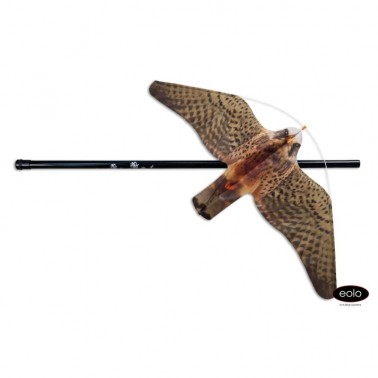
Bird Gard Pro + Hawk ScareCrow - Eolo |
Recommended for localised problems. Specific sound and visual reinforcement help create a sense of threat. |
| Parrots in several trees, facades or entry zones |
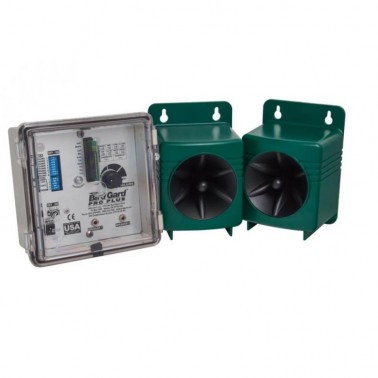
Bird Gard Pro Plus |
Two speakers make it easier to aim sound towards different activity, perching or nesting areas. |
| Colonies over wider areas, private parks or facilities |
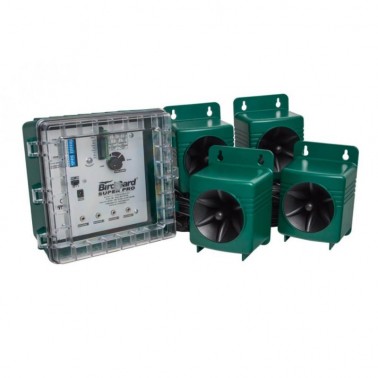
Bird Gard Super Pro |
Suitable when the area is larger or there are several pressure points. |
| Crops, estates or large high-pressure areas |
Bird Gard Super Pro Amp - Mega Blaster Pro |
High-coverage equipment for agricultural, industrial or professional applications. |
| Parrots mixed with other birds |
Bird Sound Repeller MultiSound BS-20L – Pigeons and Seagulls (Multi-Bird & Seagull Special Versions) |
Multi-species acoustic option when parrots are not the only birds present. |
| Small domestic zones with low pressure |
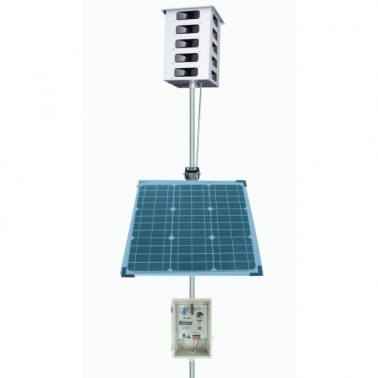
Solar Sonic Bird Repeller - WK0109 |
Can support gardens or small areas, but it is not the base solution for established colonies. |
| Crops, roosts or professional uses |
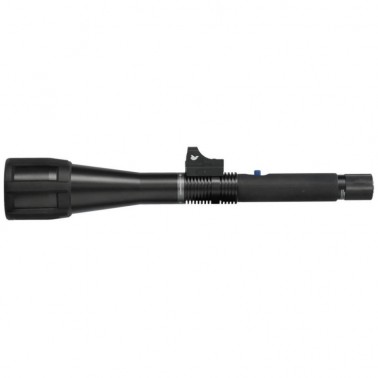
Agrilaser Handheld or Bird Laser Repeller |
Laser can help in suitable conditions, especially at dawn, dusk or on perched birds. |
| Parrot nests in trees |
Regulatory review + later deterrence |
Before acting on nests, check applicable rules and consider authorised professionals. |
How to repel Quaker parrots effectively
Quaker parrots are intelligent, social and persistent. If they have found a tree, facade, palm tree or comfortable area for nesting or feeding, one fixed object or a brief scare is rarely enough.
The most effective strategy usually works on several fronts:
- Specific sound: especially with bioacoustic systems configured for parrots.
- Visual reinforcement: a moving hawk deterrent helps simulate a predator in flight.
- Prevention: remove food sources, waste, fallen fruit and accessible rubbish.
- Nest review: if active nests exist, check the relevant regulations before acting.
- Early installation: the sooner you act, the easier it is to prevent routine use of the area.
Sounds for repelling parrots: when they work
Searches for sounds to repel parrots or scare green parrots are very common. Sound can work, but not every sound is suitable.
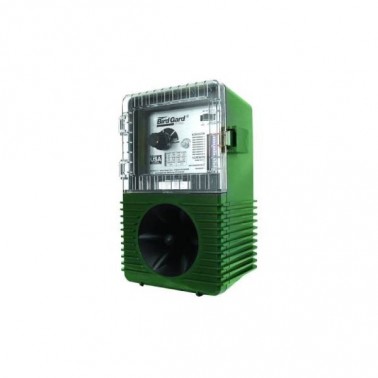
BirdGard repellers emit alarm, predator and harassment sounds that birds interpret as danger signals. For Quaker parrots, use the correct species configuration and aim speakers at perching, entry, resting and nesting-attempt zones.
Sound works better with visual reinforcement. Parrots hear danger signals and also see a moving hawk silhouette in the area, which increases the perceived risk.
To compare acoustic options, see Sonic Bird Repellers.
BirdGard for Quaker parrots
Bioacoustic BirdGard repellers are the main solution when the Quaker parrot problem is persistent. The model depends on area, number of affected trees or zones and bird pressure.
In every case, speaker orientation, persistence during the first weeks and action on the areas where parrots feel safe are essential.
Hawk ScareCrow - Eolo as visual reinforcement
The Hawk ScareCrow - Eolo is the visual reinforcement we recommend for Quaker parrots. Unlike a fixed figure, it moves with the wind and simulates a hawk in flight.
In light problems or open areas, it can help as support. In established colonies, nests or recurring groups, use it as a complement to sound. You can also compare other options in Visual Bird Repellers.
Quaker parrot nests: what to consider
Nests are one of the most common problems. They can become large, add weight to trees or structures and cause noise, dirt and constant bird presence.
Before acting on a nest, check the applicable municipal or regional rules. Even when the species is treated as invasive in some contexts, private individuals should not remove nests or capture birds without checking authorisation requirements.
After any authorised intervention, install deterrents to reduce the risk of rebuilding or nearby displacement.
Green parrots, Argentine parrots and Quaker parrots
Many customers use different names for the same practical problem: green, noisy birds that gather in trees, build large nests and cause issues in urban or agricultural areas.
Whether you search for repelling green parrots, scaring parrots or controlling Argentine parrot colonies, the main measures are similar: specific sound, visual reinforcement, prevention and legal review when nests are present.
Quaker parrot colonies in communities, gardens and crops
When presence is occasional, it may be enough to remove food, install visual reinforcement or use support equipment. When there is a colony, the strategy must be more complete.
Study the area before choosing equipment: surface, number of trees, entry points, nests, activity hours and possible acoustic impact on neighbours.
Homemade parrot deterrents: limits and precautions
Homemade deterrents may help briefly in mild cases, but established groups or nests normally require a more specific strategy. Parrots can quickly get used to shiny tape, fixed figures, hanging objects or repetitive noises.
If you use homemade methods, move them regularly, remove attractants and observe whether bird behaviour really changes.
Laser for parrots in crops and professional uses
Laser can be useful to disperse birds in suitable conditions, especially when aimed at perched birds at dawn, dusk or in controlled light.
The Agrilaser Handheld can be considered in crops, roosts, estates, farms or professional actions. The Bird Laser Repeller may also fit suitable contexts. To compare this type of solution, see Laser Bird Deterrents.
MultiSound and WK0109 as support alternatives
The Bird Sound Repeller MultiSound BS-20L – Pigeons and Seagulls (Multi-Bird & Seagull Special Versions) can be useful when the issue is not limited to parrots and several species are present.
The Solar Sonic Bird Repeller - WK0109 can support gardens, terraces or small domestic areas with low pressure, but it should not be the base solution for established colonies or active nests.
What to do before installing a parrot repeller
- Locate activity points: trees, palms, facades, antennas, roofs or feeding areas.
- Check for nests: if present, review regulations before acting.
- Remove attractants: fallen fruit, food remains, accessible rubbish or pet food.
- Clean when possible: remove debris, feathers, droppings and materials that reinforce site attachment.
- Aim sound correctly: speakers should point towards perching or entry areas.
- Reinforce with movement: a mobile visual deterrent increases the perceived threat.
- Act early: it is easier before birds consolidate roosting or nesting routines.
How to prevent parrots from returning
Removing a nest or scaring birds for a few days without prevention often fails. If the tree, facade or area remains attractive, they may return or move nearby.
- Change speaker orientation if parrots change entry routes.
- Move visual reinforcement when possible to reduce habituation.
- Avoid easy food in gardens, terraces and shared areas.
- Review nest rebuilding attempts within the applicable legal framework.
- Do not stop too soon, especially when the colony was well established.
Poison for parrots: why it is not the solution
We do not recommend poison or any indiscriminate killing method. It is dangerous, non-selective and can affect other birds, raptors, pets, wildlife and people. It may also have serious legal consequences.
The responsible alternative is non-harmful deterrence and, when nests or colonies require action, legal review and authorised professionals.
Related guides about Quaker parrots
Frequently asked questions about repelling Quaker parrots
What is the best repeller for Quaker parrots?
For persistent problems, use a BirdGard bioacoustic repeller configured for parrots, combined with a moving hawk deterrent. The model depends on surface area and affected zones.
Do sounds work to repel parrots?
Yes, when they are suitable sounds, well aimed and used consistently. They work better with moving visual reinforcement.
Which bioacoustic system do I need?
A compact model can suit localised zones, two-speaker systems help when several points need coverage, and high-coverage systems are for larger or professional applications.
Do nests have to be removed before installing a repeller?
It depends. If nests are present, check applicable regulations and consult the competent authority or specialised professionals before acting.
Can Quaker parrot nests be removed?
Nest removal may be regulated and may require authorisation. Do not act on nests without checking local rules first.
How do I scare parrots from trees?
Identify whether the tree is used for perching, feeding or nesting, then aim sound towards the tree and reinforce with a visible moving deterrent. If nests exist, check regulations first.
Does moving visual reinforcement help against parrots?
Yes. It can help as visual reinforcement, especially in open areas, gardens, communities and crops. Persistent colonies should combine it with specific sound.
Do homemade parrot deterrents work?
They may help briefly in mild cases, but parrots quickly get used to fixed or repetitive stimuli. Persistent problems usually need combined methods.
Does laser work against parrots?
Laser can be useful in professional uses, crops, roosts or places where it can be aimed correctly at perched birds, especially at dawn or dusk.
Is poison recommended for parrots?
No. Poison is dangerous, non-selective and may have legal consequences. Use non-harmful deterrence and seek advice for complex cases.
Solutions for repelling Quaker parrots at BirdGard Iberia
At BirdGard Iberia you will find non-harmful solutions for Quaker parrots, green parrots and Argentine parrots: bioacoustic repellers, moving visual reinforcement, multi-species acoustic alternatives, small-area solar support and laser for professional use. If you are unsure which solution fits your community, garden, crop, tree or facility, contact us and we will advise you free of charge.

 63 reviews