Anti-perching systems to stop birds landing on specific spots
Anti-perching systems are designed to stop birds from settling comfortably on specific spots: ledges, windows, balconies, railings, beams, aerials, chimneys, gutters, roofs, projections, solar panels or boats.
They are a particularly suitable solution when birds keep returning to the same place and cause mess, droppings, nests or recurring nuisance. In these cases, the goal is not to repel birds across a large area, but to make that landing point uncomfortable or inaccessible.
This category brings together different bird deterrent systems, anti-pigeon solutions, pigeon barriers, localised repellents and mechanical devices to prevent birds from perching. If the problem affects a wide area, such as a warehouse, a crop, an open garden or an entire roof, you may need to combine anti-perching with other types of bird repellers, such as sound, visual or ultrasonic devices.
Types of anti-perching solutions
Within anti-perching there are several product families. Each one works better for a particular type of surface, species and problem.
| Type of solution |
How it works |
Where it usually fits |
Limitations to keep in mind |
| Localised repellents |
Create an uncomfortable sensation, through texture, contact or smell, on the treated surface. |
Ledges, balconies, windows, small projections or accessible areas. |
They need to be applied to a clean surface and may require maintenance or reapplication. |
| Spikes and pigeon barriers |
Physically remove the landing surface so the bird cannot perch comfortably. |
Ledges, beams, railings, signs, walls, pipes or linear projections. |
They do not cover wide surfaces; they are designed for clear points or lines where birds perch. |
| Nets and physical barriers |
Close off the access or cover the area you want to protect. |
Trees, crops, gaps, openings or the space under solar panels. |
They need careful installation so no gaps are left for birds to get through. |
| Rotating mechanical devices |
Spin with the wind and stop the bird from finding a stable point to rest on. |
Aerials, roofs, chimneys, air-conditioning units, handrails or boats. |
Their effectiveness depends on covering the perching point well and on the device being able to move freely. |
| Nautical anti-perching solutions |
Stop seagulls and other coastal birds from settling on the surfaces of boats. |
Boats, pontoons, handrails, awnings, masts or decks. |
It is best to use products designed for environments exposed to moisture, wind and movement. |
Which anti-perching solution to choose based on the spot you want to protect
The deciding factor is usually where the bird perches. You should not choose the same system for an aerial as for a ledge, a solar panel, a railing, a chimney or a boat.
| Spot to protect |
Typical problem |
Solutions you can consider |
| Aerials |
Pigeons or other birds perch on the aerial and dirty the area below. |
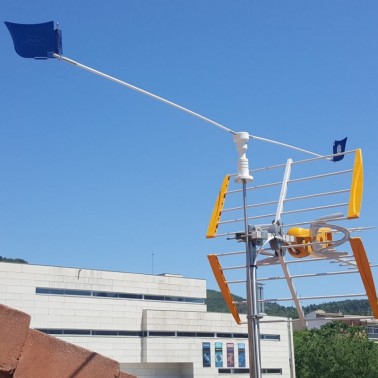
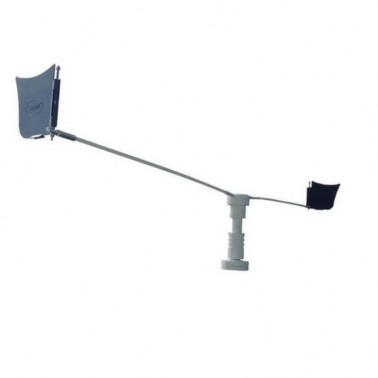
Bird Repeller for TV Aerials, designed to spin with the wind on top of the mast. |
| Roofs, chimneys and air-conditioning units |
Birds perching on high points, projections or technical roof elements. |
Bird Repeller for Roof or rotating mechanical systems depending on the affected point. |
| Ledges, sills and facade edges |
Birds perching on lines of support and leaving droppings on the area below. |
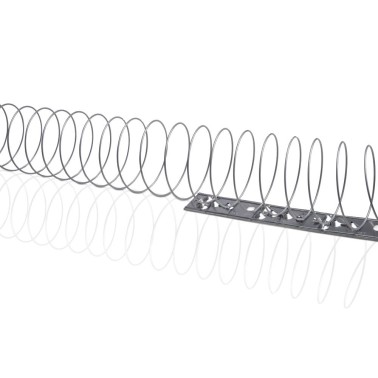
Bird Coil, pigeon spikes or localised repellents. |
| Balconies, windows and railings |
Birds settling on sills, railings or small projections. |
AviFin Liquido, Menforsan Anti-Pigeon Spray, spikes or localised solutions. |
| Solar panels |
Birds getting under the panels, sheltering or nesting in the gap underneath. |
BirdBlocker and specific systems from the bird deterrents for solar panels category. |
| Boats and pontoons |
Seagulls or other coastal birds perching on handrails, awnings, masts or decks. |
StopGull Air, StopGull S27 and solutions from the bird deterrents for boats category. |
| Trees, orchards and crops |
Birds reaching fruit, seeds or specific areas of a crop. |
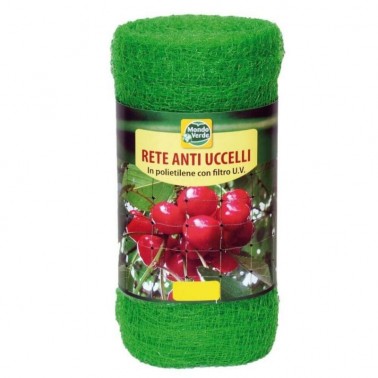
Bird Netting or combined solutions depending on the species and the surface. |
Bird deterrents for roofs, aerials and chimneys
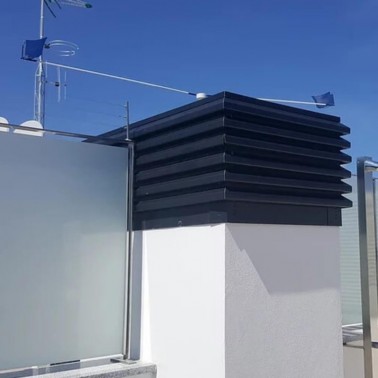
Many searches for bird deterrents for roofs are related to birds perching on aerials, chimneys, air-conditioning units, roof edges or technical roof elements. In these cases, rotating mechanical systems are often an interesting option because they make perching difficult through movement.
The Bird Repeller for TV Aerials is one of the most specific solutions to stop birds from perching on aerials. It spins with the wind and is designed to act right at the point where the bird tries to land.
For roofs, chimneys or larger roof elements, you can consider the Bird Repeller for Roof - Eolo Urbano, especially when the problem appears in high areas where birds find a comfortable resting point.
Repellents, gels and scents to deter birds
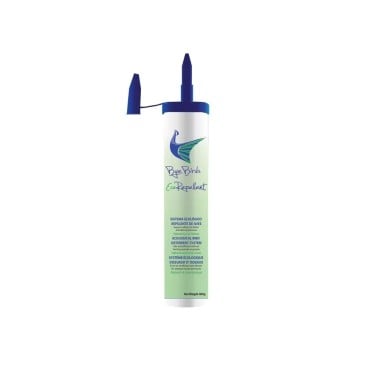
In some cases, the goal is to treat specific perching points with localised products. Gels or liquid repellents can help make a ledge, window, edge or specific surface less attractive to birds.
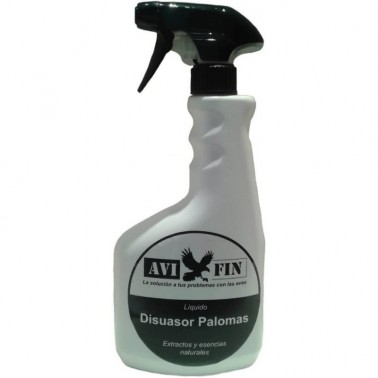
AviFin Liquido is a liquid repellent with a mint scent, used especially in cases of pigeons. It can be useful when you are looking for a localised solution based on smell and a deterrent effect on a specific surface.
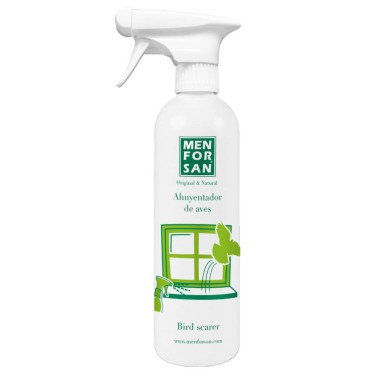
Menforsan Anti-Pigeon Spray is another localised repellent option for controlling pigeons at specific points.
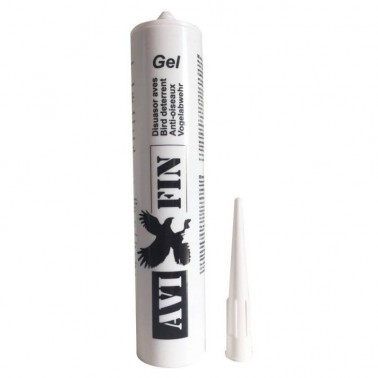
AviFin Gel is one of the benchmark solutions in this family to stop pigeons and other birds from perching on balconies, ledges and specific spots. You can check the product page for technical information, videos and customer reviews.
Pigeon barriers and anti-perching spikes
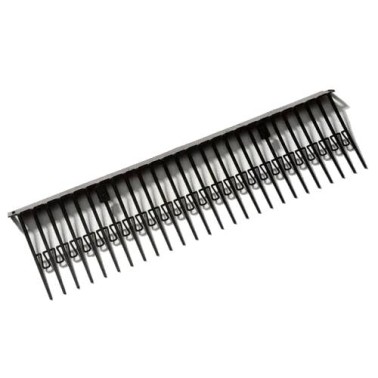
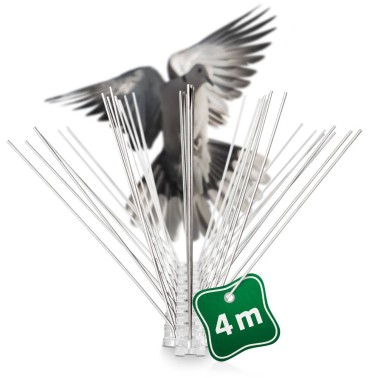
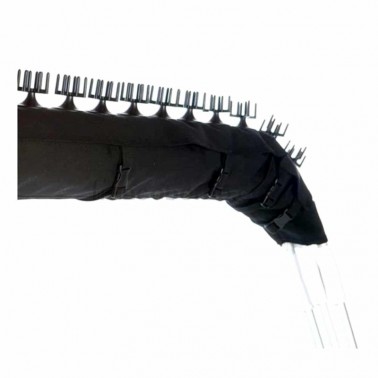
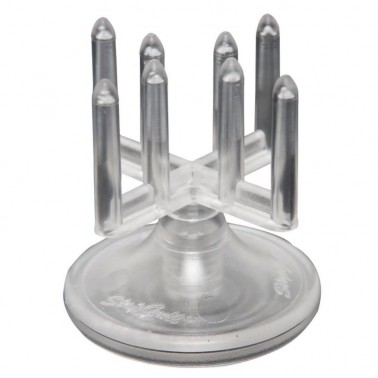
Pigeon barriers and spikes are common solutions when birds perch on clear lines of support: ledges, walls, sills, railings, windows or facade edges. Their function is to physically prevent the bird from settling comfortably.
The Bird Coil - Pigeon Deterrent is a tidy, discreet alternative for covering linear stretches. The Pigeon Spikes are flexible and can adapt to different types of surfaces, even curved ones.
With this type of installation, it is important to measure the length to be protected carefully, check whether the surface allows the chosen system to be fixed correctly, and avoid leaving uncovered stretches.
Anti-perching for solar panels and boats
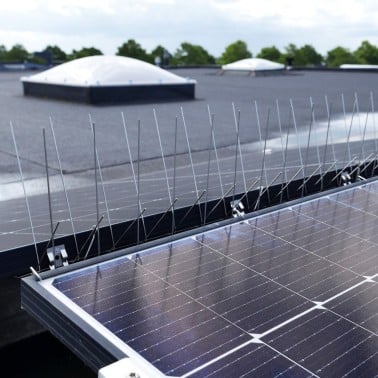
On photovoltaic installations, the problem is usually twofold: birds can perch on the structure, but they can also get into the gap under the panels. When this happens, the priority is usually to physically block access beneath the modules.
BirdBlocker is the main solution to protect solar panels against birds entering and nesting. Although it is part of the anti-perching world, this case is covered in more detail in the specific bird deterrents for solar panels category.
On boats, pontoons and nautical surfaces, the problem is usually related to seagulls and other coastal birds that perch on handrails, awnings, masts, decks or mooring areas. In these cases it is best to use systems designed for environments exposed to wind, moisture and movement, such as StopGull Air or StopGull S27. You can also check the specific bird deterrents for boats category.
Anti-perching for pigeons, seagulls and other birds
Anti-perching solutions are frequently used to repel pigeons, especially when they perch on ledges, windows, balconies, roofs, aerials or solar panels. In these cases, the goal is not only to scare the bird away, but to stop it from continuing to use the same spot as a comfortable resting point.
In the case of seagulls, anti-perching can be especially useful on boats, pontoons, handrails, decks or coastal areas where the birds perch repeatedly.
For other species, such as sparrows, starlings, crows or blackbirds, anti-perching can be part of a broader strategy. If the problem affects a large surface, a warehouse or a crop, you may need to combine it with sonic bird repellers, visual bird repellers or other measures.
Difference between anti-perching, sound and visual deterrents
Anti-perching systems act on the point where the bird settles. They are useful when birds perch in specific places, such as ledges, windows, aerials, railings, chimneys or roof edges.
Sonic bird repellers work over a wider area through acoustic signals. They can be more suitable for warehouses, crops, roofs or spaces where you want to create deterrent pressure over a larger area.
Visual bird repellers generate movement or visual threat stimuli. They are usually used outdoors, in gardens, crops, roofs or as reinforcement for other solutions.
When the problem is well established, it is often best to combine several methods. For example, an anti-perching system at the point where the birds settle, together with a prior cleaning and a visual or sound reinforcement if the affected area is wide.
Common mistakes when installing an anti-perching system
- Not cleaning before installing: if droppings, feathers, nest remains or signs of presence are left, birds may keep recognising the area as their own.
- Leaving uncovered gaps: with spikes, nets or physical barriers, a single unprotected stretch can be enough for birds to perch or get in again.
- Not measuring the surface properly: before choosing spikes, coils, nets or rotating systems, it is worth measuring the exact length or point to be protected.
- Choosing on price alone: a cheap product may not match the species, the surface or the type of perching.
- Using anti-perching as the only solution on wide surfaces: if birds enter a warehouse, fly over a roof or affect a crop, it is usually better to combine it with sound, visuals or closing off access.
- Not checking for active nests: if there are eggs or chicks, it is best to act with caution and review the applicable regulations before intervening.
Tips before installing an anti-perching solution
- Identify the species: pigeons, seagulls, sparrows and starlings do not behave the same way.
- Locate the exact perching point: anti-perching works best when it is installed on the spot the birds use repeatedly.
- Clean the area before installing: whenever possible, we recommend removing droppings, feathers, nest remains and signs of presence.
- Check for active nests: if there are eggs or chicks, it is worth reviewing the applicable regulations before intervening.
- Assess the surface: a narrow ledge, an aerial, a chimney, a railing or a solar panel may require different solutions.
- Combine methods if the problem is established: in some cases it may be advisable to use anti-perching together with visuals, sound, physical barriers or closing off access.
Frequently asked questions about anti-perching solutions for birds
What is an anti-perching solution for birds?
It is a system designed to stop birds from settling comfortably on a specific spot, such as a ledge, window, railing, aerial, chimney, roof, solar panel or boat.
When is it best to use anti-perching?
It is best to use it when the problem is localised on specific support points. If the birds always perch in the same place, an anti-perching solution can be more suitable than a system designed to cover a wide surface.
What is the difference between spikes, gels and rotating systems?
Spikes and coils create a physical barrier on linear areas. Gels or localised repellents create an uncomfortable sensation on the treated area. Rotating systems make perching difficult through movement, especially on aerials, roofs or raised elements.
Does anti-perching work for pigeons?
Yes. It is one of the most widely used solutions when pigeons perch on windows, ledges, balconies, roofs, aerials or solar panels. The choice of system depends on the affected point and the environment.
Does anti-perching work for seagulls?
Yes, especially on boats, pontoons, handrails, decks or coastal areas where seagulls perch repeatedly. In these cases it is worth considering solutions designed for nautical or outdoor use.
Do anti-perching spikes harm birds?
They are not designed to hurt the bird, but to remove the landing surface and make it look for somewhere else to perch. It is important to choose the right system and install it correctly.
Do I have to clean before installing an anti-perching system?
Yes. Whenever possible, it is best to clean the area and remove droppings, feathers, nest remains or signs of presence. This helps reduce the birds' attachment to the place.
Can anti-perching be combined with other repellers?
Yes. When the problem affects a wide area or the birds are already very used to the place, it may be advisable to combine anti-perching with visual bird repellers, sound, physical barriers or closing off access.

 16 reviews