Sonic bird repellers: acoustic, sonic and bioacoustic solutions
Sonic bird repellers use acoustic signals to make certain birds perceive an area as less safe. Depending on the model, they may emit alarm calls, distress calls, predator sounds, electronic sounds or combinations of sound, ultrasound and light.
At BirdGard Iberia you will find different types of sonic bird deterrents, from professional units with species-specific sounds to solar, acoustic or combined models for specific areas. The right choice depends on the species, the surface to protect, the environment and the level of bird pressure.
When to choose a sonic bird repeller
Acoustic bird deterrents are often especially useful in outdoor areas, large surfaces, warehouses, roofs, crops, farms, industrial facilities or places where audible sound is not a problem.
| Situation |
Why a sonic bird repeller may be suitable |
Solution you can consider |
| Warehouses, storage areas, factories or industrial facilities |
They help create sound pressure on birds that enter, perch or remain near the installation. |
BirdGard Pro, BirdGard Pro Plus, BirdGard Super Pro, MultiSound BS-20L |
| Crops, farms, agricultural sites or large open areas |
Sonic devices can cover broad areas and work on specific species depending on the problem. |
BirdGard Pro, BirdGard Pro Plus, BirdGard Super Pro, BirdGard Super Pro Amp, MultiSound BS-20L |
| Pigeons, seagulls, starlings or other birds on roofs or outdoor areas |
Sound can help reduce bird presence when the environment allows audible emissions. |
BirdGard, MultiSound BS-20L, WK0109 depending on the surface and context |
| Roofs, gardens or specific outdoor areas |
A more compact, autonomous unit with visual reinforcement through LED flashes may be useful. |
Solar Sonic Bird Repeller WK0109 |
| Persistent problems or birds already used to the area |
In established cases, it is often advisable to combine sound with visual stimuli or anti-perching measures. |
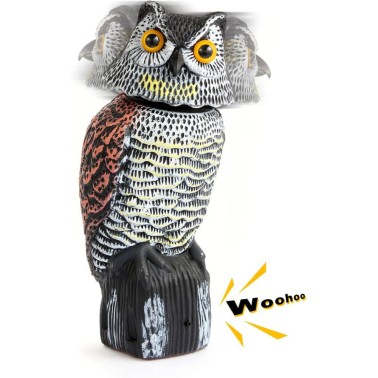
Sonic bird repeller + Hawk ScareCrow Eolo or other complementary solutions |
| Residential environments that are very sensitive to noise |
When audible sound may cause disturbance, it is advisable to consider a more combined and localised strategy. |
BroadBand Pro + visual bird repellers + anti-perching solutions, depending on the affected point |
Sonic bird repeller models
Within this category there are different models, with different coverage levels and uses. Some units are designed for professional use on large surfaces, while others are more suitable for specific areas, noise-sensitive environments or as outdoor support.
| Model |
Type of solution |
Typical use |
Link |
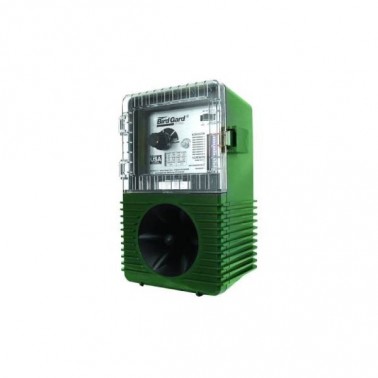
| BirdGard Pro |
Compact bioacoustic bird repeller |
Small and medium-sized areas, gardens, crops or specific outdoor zones. Approximate coverage of up to 0.6 hectares. |
See BirdGard Pro |
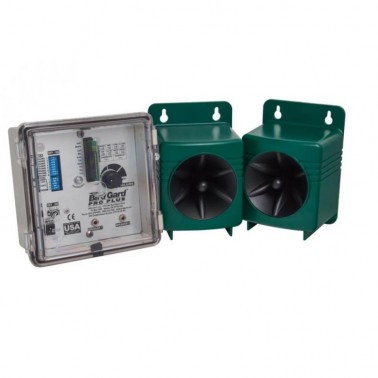
| BirdGard Pro Plus |
Bioacoustic bird repeller with external speakers |
Larger areas where it is useful to direct sound towards different points. Approximate coverage of up to 1.2 hectares. |
See BirdGard Pro Plus |
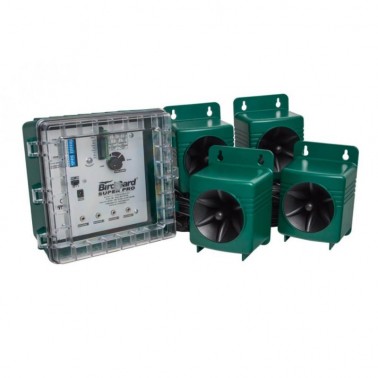
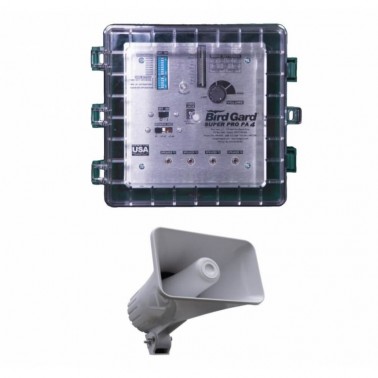
| BirdGard Super Pro |
Professional bioacoustic bird repeller with four speakers |
Large surfaces, warehouses, crops, roofs or agricultural sites. Approximate coverage of up to 2.4 hectares. |
See BirdGard Super Pro |
| BirdGard Super Pro Amp |
High-coverage bioacoustic bird repeller |
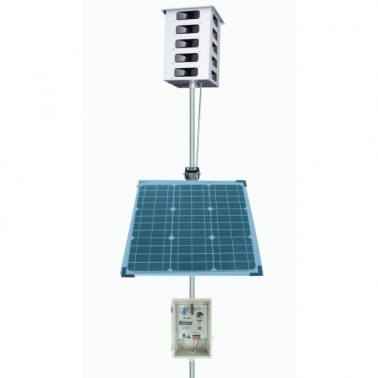
Large-scale agricultural or industrial applications. Unit with a 20-speaker tower and solar panel. Approximate coverage of up to 12 hectares. |
See BirdGard Super Pro Amp |
| MultiSound BS-20L |
Acoustic bird deterrent |
Alternative sonic solution for starlings, pigeons, seagulls and other birds. Available in multi-bird and seagull special versions. |
See MultiSound BS-20L |
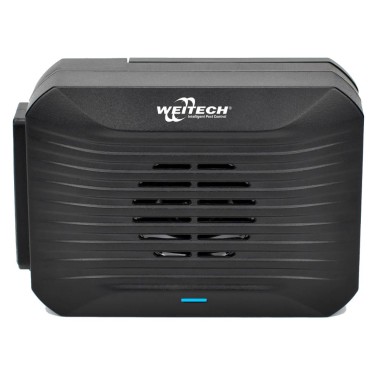
| BroadBand Pro |
Combined sound and ultrasound bird repeller |
An interesting solution for environments where a more discreet or combined strategy is required. It can be used together with visual bird repellers and anti-perching systems depending on the affected point. |
See BroadBand Pro |
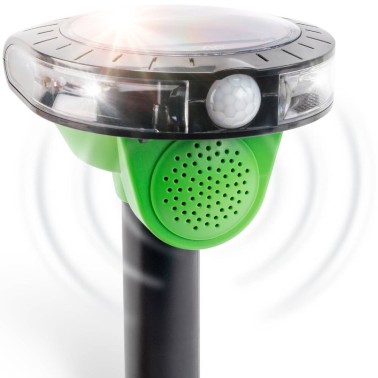
| Solar Sonic Bird Repeller WK0109 |
Solar sonic bird repeller with LED flashes |
Specific outdoor areas, roofs, gardens or spaces where an autonomous unit with birds of prey sounds and visual reinforcement is required. |
See WK0109 |
How acoustic bird deterrents work
Birds, especially when they live or move in flocks, react to danger signals. Some sonic bird repellers reproduce alarm or distress calls from the target species. Others use birds of prey sounds, such as hawks or eagles, or electronic sounds that help create discomfort in the protected area.
The purpose is not to harm birds, but to create deterrent pressure so that they do not perceive the environment as a comfortable place to feed, perch, sleep or nest.
In BirdGard bioacoustic models, the choice of chip or sound card depends on the species you want to repel. In other models, such as MultiSound BS-20L, WK0109 or BroadBand Pro, the approach may be broader or may combine sound with other stimuli.
Sonic bird repellers by species
Before choosing a sonic unit, it is important to identify the species. Pigeons, seagulls, sparrows, starlings and crows do not respond in the same way. Their behaviour also changes depending on whether the birds are simply perching, looking for food, entering a warehouse or nesting.
| Species |
Typical use of sonic bird repellers |
Recommended page |
| Pigeons |
Sonic units can be useful in warehouses, factories, roofs or large surfaces. On specific perching points, it may be better to combine them with anti-perching systems. |
See solutions to repel pigeons |
| Seagulls |
Sonic bird repellers are often used on roofs, warehouses, coastal areas, industrial facilities or large open surfaces. |
See solutions to repel seagulls |
| Sparrows |
Sparrows can be difficult to control when they enter warehouses or find shelter and food. Sound can be part of a combined strategy. |
See solutions to repel sparrows |
| Starlings |
Bioacoustic bird repellers are often used in crops, fruit trees, vineyards or agricultural areas affected by flocks. |
See solutions for starlings |
| Crows |
Sound can help in rural areas, crops or farms where crows repeatedly find food. |
See solutions to repel crows |
Audible sounds, ultrasound and visual solutions
A sonic bird repeller is not the same as an ultrasonic bird repeller. Sonic devices emit sounds that people can hear and are often used outdoors, in warehouses, roofs, crops or environments where noise is not a major issue. Ultrasonic bird repellers are more discreet, but their range and usefulness depend heavily on the environment and the species.
Some units, such as BroadBand Pro, combine sound and ultrasound. They can be an interesting option when a more complete solution is required or when different stimuli should be integrated into a bird control strategy.
In many cases, especially with pigeons, seagulls or sparrows, it may be advisable to combine sound with a visual stimulus. The combined effect of both devices can reinforce the overall deterrent strategy: birds hear alarm calls or predator sounds while also seeing a visual threat in the area.
To reinforce the action of sonic devices, you can also visit our section on visual bird repellers.
What to consider before installing a sonic bird repeller
- Identify the species: the choice of sound or model depends largely on the bird causing the problem.
- Calculate the surface: protecting a garden is not the same as protecting a warehouse, a roof, a farm or a large open area.
- Assess the acoustic environment: if there are homes, offices or people working nearby, it is important to check whether audible sound may cause disturbance.
- Check for nests, food or shelter: when birds find food or resting areas, they may be more attached to the location.
- Clean the area before installation: whenever possible, we recommend removing droppings, feathers, nest remains and signs of bird presence. This helps prevent birds from perceiving the area as their own.
- Combine methods if the problem is established: in some cases, it is advisable to combine sound, visual deterrents, anti-perching systems, physical barriers or access closure.
Frequently asked questions about sonic bird repellers
What is a sonic bird repeller?
It is a device that emits acoustic signals to deter birds from remaining in an area. Depending on the model, it may reproduce alarm calls, predator sounds, electronic sounds or combinations of sound and light.
Do sonic bird repellers work for all birds?
Not all models work in the same way for every species. Some units, such as BirdGard bioacoustic models, use sound chips or sound cards that are specific to the target species. Other models, such as MultiSound BS-20L or WK0109, have a broader approach or combine different stimuli.
What is the difference between a sonic bird repeller and an ultrasonic one?
Sonic bird repellers emit signals that are audible to people and are usually used outdoors or on large surfaces. Ultrasonic devices are less perceptible to the human ear, but they are not always the best option for large surfaces or for certain bird species.
Is it advisable to combine a sonic bird repeller with a visual bird repeller?
Yes, especially when the problem is already established. The combination of sound and visual stimuli can reinforce the perception of risk in the protected area. For example, a sonic bird repeller can be combined with a hawk scarecrow on roofs, warehouses, crops or open areas.
Do sonic bird repellers disturb people?
These devices emit audible sounds, so they may be perceived by nearby people. For this reason, it is advisable to assess the environment before installing them, especially if there are homes, offices, neighbours or workers nearby.
What should I do before installing a sonic bird repeller?
We recommend identifying the species, reviewing the surface to protect, checking for food, nests or shelter, and cleaning the area to remove droppings, feathers or other signs of bird presence. This helps improve the overall strategy.


 1 review